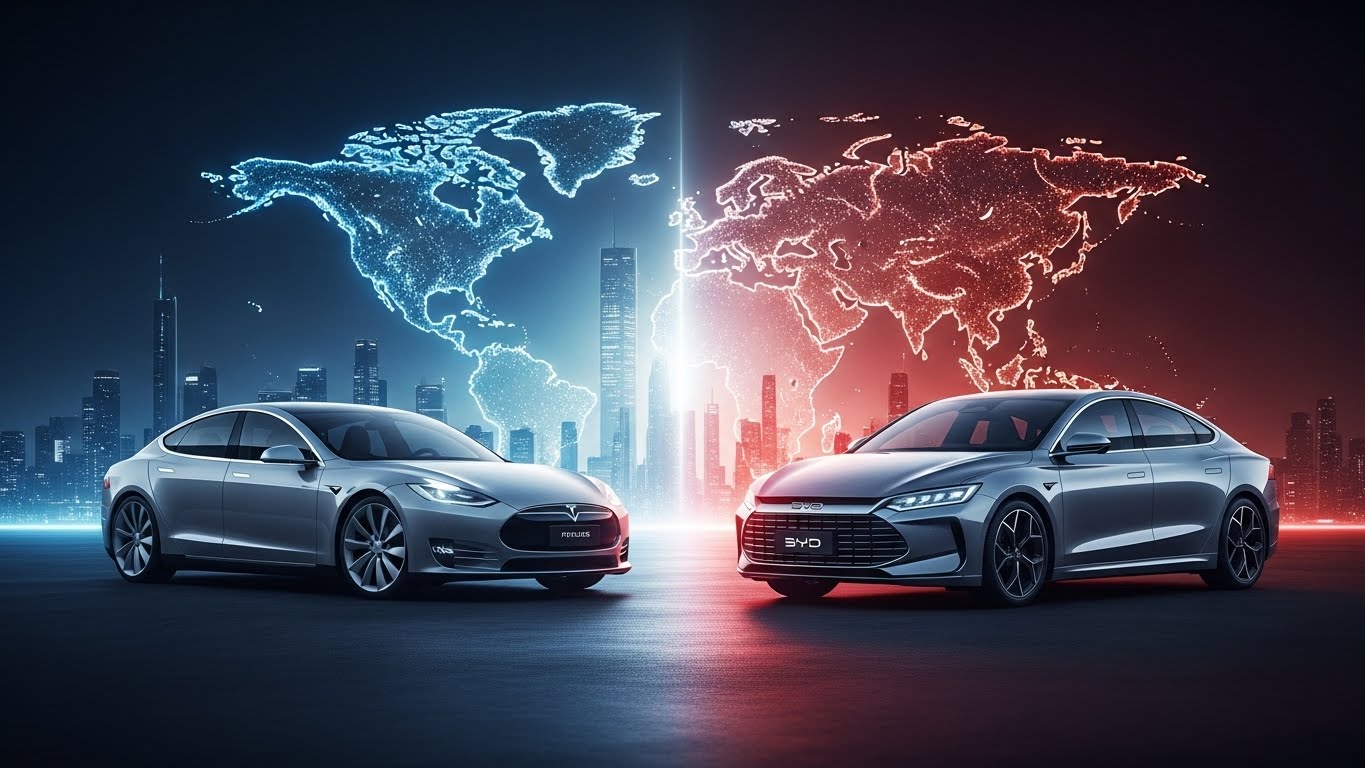
For more than a decade, Tesla was synonymous with electric vehicles. It wasn’t just the world’s most valuable EV company — it was the undisputed global leader in electric car sales, innovation, and brand influence. That era officially ended in 2026, when China’s BYD surpassed Tesla to become the world’s #1 electric vehicle maker by sales volume.
This shift did not happen overnight. Instead, it resulted from evolving market conditions, strategic decisions, pricing pressures, government policies, and the rapid rise of Chinese EV manufacturers — with BYD at the forefront.
So why did Tesla lose its crown to BYD in 2026? And what does this power shift mean for the future of the global EV market? Let’s break it down.
Advertisement
Tesla’s Rise: How It Became the World’s Leading EV Maker
Tesla’s ascent to the top of the EV industry is one of the most remarkable success stories in modern automotive history.
Founded in 2003, Tesla did more than build electric cars — it redefined what an EV could be, combining performance, software, and sustainability into a compelling package.
Key factors behind Tesla’s dominance
- First-mover advantage in premium long-range electric vehicles
- Breakthrough models such as the Model S, Model 3, and Model Y
- Industry-leading battery efficiency and software integration
- A global Supercharger network that significantly reduced range anxiety
- A powerful brand identity centered on innovation and clean energy
By the early 2020s, Tesla was selling more EVs worldwide than any other automaker, while many traditional manufacturers struggled to pivot away from internal combustion engines. However, this early lead would not last forever.
The Global EV Market in 2026: A Much Tougher Battlefield
By 2026, the electric vehicle market had fundamentally transformed.
What was once a niche, innovation-driven sector had evolved into a mass-market, price-sensitive global industry, where scale and affordability mattered as much as technology.
Key changes in the EV landscape
- Rapid EV adoption across China, Europe, and Southeast Asia
- A surge of new electric vehicle brands entering the market
- Competition shifting from “who has the best technology” to who can scale fastest and sell at lower prices
- Chinese automakers dramatically improving quality, design, and reliability
Tesla was no longer competing mainly with slow-moving legacy automakers. Instead, it faced highly efficient, vertically integrated Chinese EV giants that could move faster and cheaper.
BYD’s Breakthrough: How BYD Overtook Tesla
BYD’s rise to the top of the global EV market was driven by long-term planning, manufacturing scale, and cost efficiency, rather than marketing hype.
Record-breaking sales and production scale
In 2025, BYD sold more than 2.2 million electrified vehicles, including battery electric vehicles and plug-in hybrids. By comparison, Tesla delivered around 1.6 million EVs, marking its second consecutive year of declining sales.
This widening volume gap officially made BYD the world’s largest EV maker by sales.
Vertical integration as a competitive advantage
Unlike most automakers, BYD:
- Manufactures its own batteries, including the Blade Battery
- Produces key components in-house
- Controls large portions of its supply chain
This vertical integration enables BYD to lower costs, reduce supply chain risks, and scale production more efficiently than competitors. Tesla, while technologically advanced, still depends more heavily on external suppliers.
Affordable EVs for the mass market
Tesla’s vehicle lineup remains relatively narrow and focused on mid-to-premium price segments. BYD, in contrast, offers a broad range of vehicles, including:
- Entry-level budget EVs
- Mid-range family sedans
- SUVs, vans, and commercial EVs
- Plug-in hybrids for markets not yet ready for full electrification
This diverse and affordable product lineup allowed BYD to expand rapidly in emerging markets — an area where Tesla struggled to gain traction.
Tesla’s Sales Slowdown: What Went Wrong?
Tesla did not collapse — but it lost momentum while competitors accelerated.
Declining sales in key markets
Tesla faced weakening demand in China, its most competitive market, along with slower growth in Europe due to subsidy reductions. In North America, the market showed signs of saturation. Meanwhile, BYD continued expanding aggressively into international markets.
An aging vehicle lineup
Tesla’s core models remained largely unchanged for several years. During the same period, competitors introduced:
- New vehicle designs
- Multiple body styles
- Region-specific models
Although Tesla continued improving software and efficiency, consumer-facing variety lagged behind industry rivals.
Price cuts and margin pressure
To defend market share, Tesla repeatedly lowered vehicle prices. While this helped stimulate short-term demand, it also:
- Reduced profit margins
- Weakened the brand’s premium positioning
- Signaled softer demand to investors
BYD, with lower production costs, absorbed price competition far more effectively.
EV Policies, Incentives, and Geopolitics Played a Major Role
Government policy played a critical role in shaping the Tesla vs BYD rivalry.
Key policy shifts included:
- Reduced or expired EV tax credits in the US and Europe
- Strong state support for EV adoption within China
- Trade barriers and tariffs that influenced pricing strategies
BYD benefited from a massive domestic market, supportive industrial policy, and proximity to the world’s largest battery supply chain. Tesla, operating across multiple regions, faced a more fragmented and uneven policy environment.
Brand Perception and Leadership Challenges at Tesla
Tesla remains a powerful brand, but public perception has shifted in certain markets.
Key challenges included:
- Leadership controversies that affected consumer sentiment
- Intensifying competition offering similar or superior features
- Reduced novelty compared to Tesla’s early years
While Tesla is still widely viewed as innovative, it no longer feels untouchable.
Tesla vs BYD: A Side-by-Side Comparison
| Category | Tesla | BYD |
|---|---|---|
| Global EV Sales | ~1.6M | ~2.2M |
| Price Range | Mid to Premium | Budget to Mid |
| Battery Production | Partial | Fully In-House |
| Model Variety | Limited | Extensive |
| Core Markets | US, Europe | China, Global South |
This comparison highlights why BYD won on volume, even as Tesla continues to lead in software and brand recognition.
Why Losing the #1 Spot Doesn’t Mean Tesla Is Finished
Losing the top sales position does not mean Tesla is failing.
Tesla still leads in:
- Vehicle software and over-the-air updates
- Autonomous driving research
- Energy storage and charging infrastructure
- AI and robotics initiatives
Future projects such as robotaxis, next-generation vehicle platforms, and energy solutions could significantly reshape Tesla’s long-term trajectory.
What BYD’s Victory Means for the Future of EVs
BYD’s rise reflects a broader shift within the global EV industry.
Implications for consumers
- More affordable electric vehicles worldwide
- Faster EV adoption
- Greater choice across multiple price segments
Implications for the industry
- China’s growing influence in global automotive markets
- Increased pressure on profit margins
- Faster innovation cycles
The EV race is no longer dominated by a single company — it’s now a global competition.
What to Expect Next: Tesla vs BYD Beyond 2026
Looking ahead:
- Tesla may reclaim leadership through innovation rather than sheer volume
- BYD could strengthen its position through scale and affordability
- Policy changes, technological breakthroughs, and consumer demand will shape the next phase of competition
The rivalry is far from over.
Conclusion: A Changing of the Guard in the EV World
Tesla lost its crown as the world’s #1 EV maker to BYD in 2026 not because it failed, but because the market evolved.
BYD mastered scale, affordability, and supply chain control, while Tesla faced slowing growth, rising competition, and shifting policy environments.
This transition reflects a maturing EV industry where price, volume, and accessibility now matter as much as innovation. For consumers, this is good news. For automakers, the race has only just begun.
Call to Action
What’s your take — can Tesla regain the top spot, or is BYD the new long-term EV leader?
Share your thoughts in the comments and explore our other in-depth articles on electric vehicles, clean energy, and the future of mobility.
Recommended Reading:
- Should you buy a used Electric Car in 2026? Why prices are dropping 30%!
- EV Environmental Impact: The Full Truth—Are Electric Cars Truly Greener Than Gasoline?
- EV Charging Revolution: Innovations Making Electric Cars Accessible
Advertisement